Concrete Contractor Portland Maine
(207) 292-7649Patterned and colored patios, walks and borders, priced in writing
Stamped and decorative concrete in Portland, ME
Stamped patterns, color, exposed aggregate and borders, on concrete mixed and sealed for frost and salt.
Pattern, color and texture on concrete built for Maine
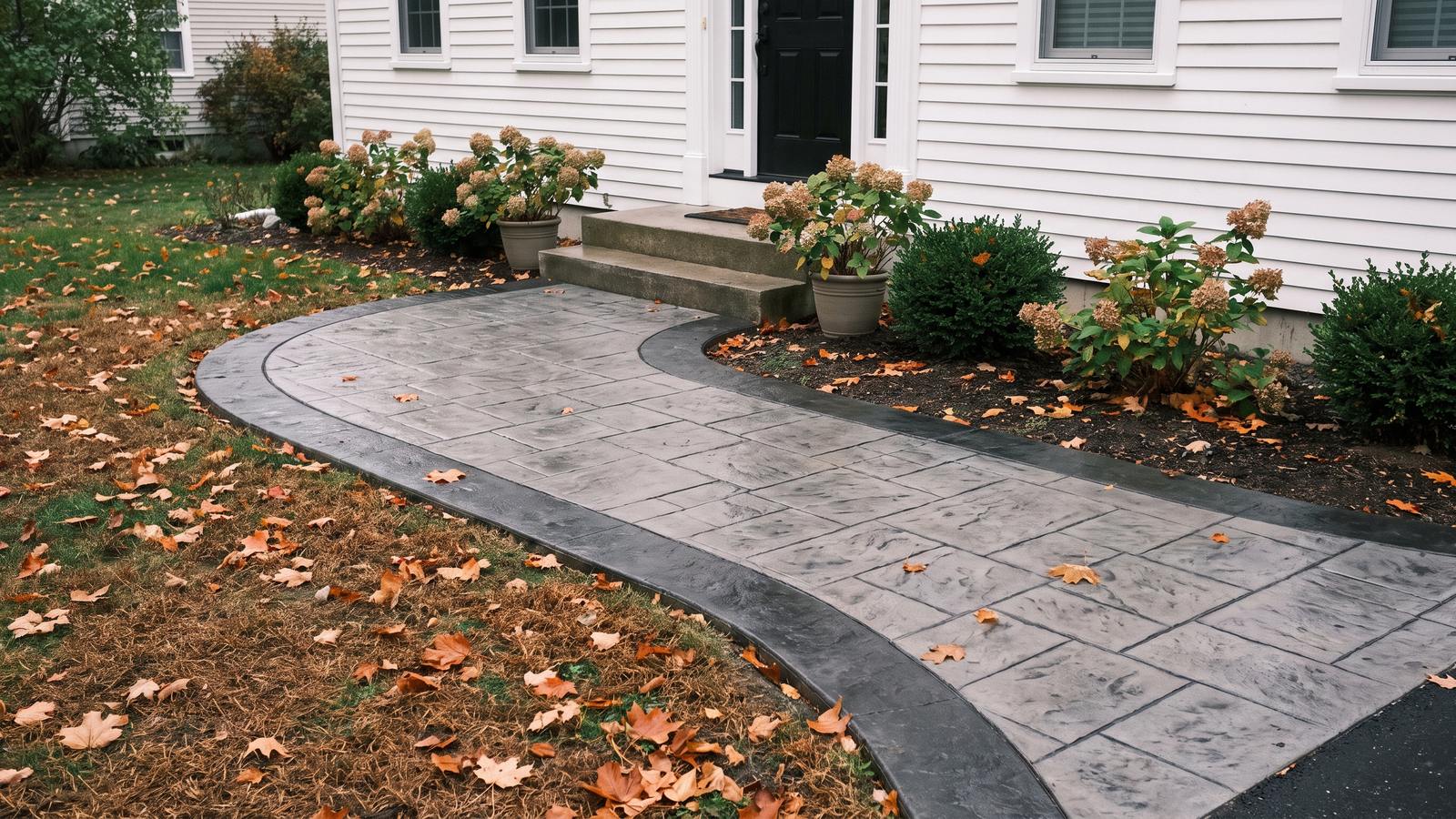
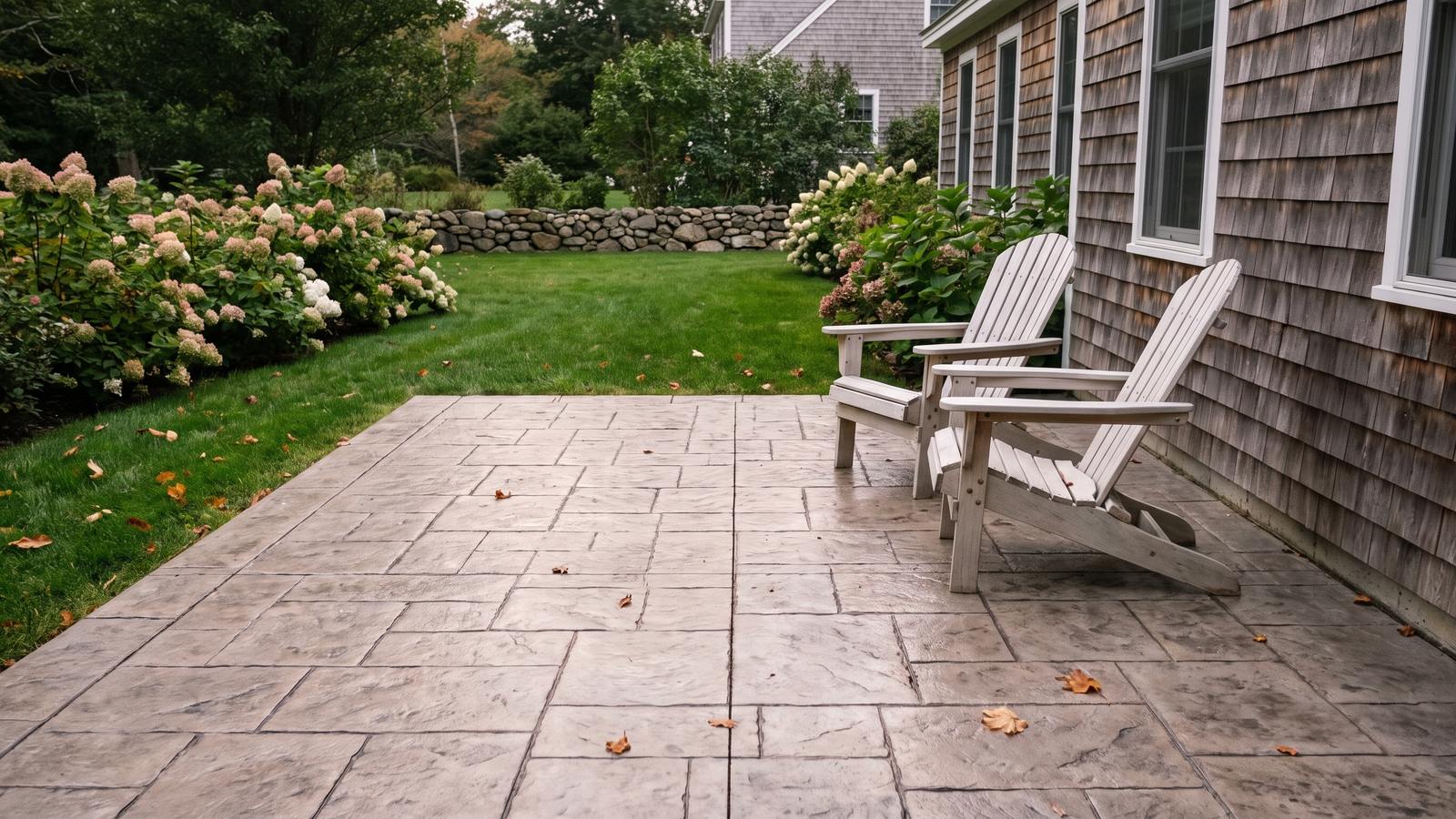
We pour stamped and decorative concrete in Portland, ME: patterned and colored patios, front walks and entries, exposed aggregate, and stamped or colored borders on broom-finished driveways and walks.
Stamped concrete starts as an ordinary slab, placed, leveled and floated. While the surface can still take an impression, rubber pattern mats are laid on it and tamped in, so the slab reads as slate, brick, cobblestone or wood plank. Color goes into the mix, onto the surface or both, and a release agent keeps the mats from sticking and adds a second, contrasting color.
It suits the places people see most: a backyard patio, the walk to the front door, an entry landing, a border along a driveway. On steps, steep walks and the spots that ice up first, a plain broom finish is often the better surface, and we will say so.
Under the pattern, the base, slope and joints are the same as for any concrete patio or walkway. As a concrete contractor in Portland, we list the base, the mix, the pattern, the color and the sealer as separate lines in the written quote, so you can see what the decorative work adds.
Free quote
Get a free written quote
Stamping patterns, integral color and color hardener
A stamped finish comes down to three choices: the pattern, the base color and the release color that adds contrast.
Pattern mats come in stone, brick and wood designs, from ashlar slate and cobblestone to herringbone brick and wood plank; ACI's guide to decorative concrete describes flatwork made to look like slate, brick or natural stone. The Decorative Concrete Council of the American Society of Concrete Contractors (ASCC) says the concrete must be stiff enough to walk on yet workable enough for the mat's ridges to press in, and a surface that sun or wind has crusted will tear. Such tears are cosmetic: on projects monitored for nearly ten years of freezing and thawing, ASCC reports, they did not grow.
- Integral color: iron oxide pigment mixed into the concrete, coloring all of the paste. ASCC notes that extra water weakens the tint, so none is added on site.
- Color hardener: cement, pigment and fine aggregate broadcast over the fresh slab and worked in; ACI says it colors and hardens the surface, so the color stays at the top.
- Release color: a powder or liquid release keeps the mats from sticking and leaves a contrasting color; the excess is rinsed off one to three days later.
Expect some variation: ASCC says color charts and chips should not be expected to match the color in place, and NRMCA notes that a texture or pattern makes differences between truckloads harder to see. A white film on new colored concrete is often efflorescence, which ASCC calls normal; it is cleaned off before sealing.
Exposed aggregate, broom finishes and borders, and where each fits
Not every decorative job needs a stamp; exposed aggregate, a broom finish or a border may serve better.
ACI defines an exposed-aggregate finish as removing the outer skin of mortar, generally before the concrete has hardened, to expose the coarse aggregate; a surface retarder sprayed on the fresh slab delays the set of that top layer so it can be removed, or decorative stone is seeded into the surface. Unless stone is seeded in, what shows is the mix's own aggregate, so the mix is chosen for the look.
A broom finish, the texture left by drawing a broom across fresh concrete, is the plainest option, and NRMCA calls for broom texture on outdoor walks, patios and driveways to give a non-slip surface. A stamped or colored border around a broom-finished field gives a driveway or long walk the look while the field keeps its grip.
- Backyard patios and paths: the natural home for pattern and color.
- Front walks and entries: shoveled, salted and walked on wet, so they need texture and grit in the sealer.
- Driveways: a stamped or colored border along the edges of a broom-finished concrete driveway.
- Steps and steep walks: usually better broom-finished, for grip.
How stamped concrete holds up to Maine winters and deicers
Stamped concrete lasts here when the concrete under the pattern is right, it is cured without blotching the color, and its sealer is kept up.
At the Portland Jetport the low reaches 32°F or colder on 144.1 days in an average year (NOAA). For outdoor slabs that will see deicers, NRMCA recommends 4,000 psi concrete with about 6 percent total air when the stone is 3/4-inch or 1-inch, and that is what we order for stamped work. NRMCA also warns that excessive finishing reduces entrained air at the surface, so stamping is done without overworking it.
Color hardener takes care on air-entrained concrete: NRMCA's guidance on delamination says to avoid dry shakes on it, and ASCC says that in cold climates the air content should not exceed the upper limit for frost resistance. Integral color avoids the question, so it is the simpler choice here; with a hardener, we hold the air to that limit.
Curing differs too: ASCC says water curing discolors decorative flatwork and plastic or curing paper leaves mottling, and NRMCA says plastic should not be used where appearance matters, so stamped work gets an ASTM C1315 cure-and-seal once the release is rinsed off and the surface is dry. Control joints go a quarter of the slab deep and, ASCC notes, can sometimes hide in the pattern's grout lines, though some random cracking should still be expected.
Sealing and grip
ASCC says sealer keeps water, deicing chemicals and stains out of stamped concrete and brings out its color. Penetrating sealers work inside the pores and mostly leave the color as it is; film-forming sealers are the most common on stamped work because they deepen it. For deicer exposure NRMCA recommends a breathable silane or siloxane sealer. Gloss can be slippery, so ASCC calls for an anti-skid additive made for the sealer at the first seal and every reseal.
What sets the price, and when stamped concrete is poured
Stamped or decorative concrete is priced as a slab first, then by the pattern, the color, the crew on pour day and the sealing.
- The slab: size, shape, tear-out, the base and truck access.
- Pattern: the area stamped, the mats it takes and hand work at the edges.
- Color: integral color, a broadcast hardener, a release color, or a mix.
- Pour day: the stamping window is short, so it takes more hands than a broom finish.
- Sealing: washing off the release, the cure-and-seal, the sealer and grit, and resealing as it wears.
- Border or full stamp: a border around a broom-finished field costs less than stamping it all.
Each is priced separately in the written quote; see what moves the price of concrete work in Portland for the factors behind every job.
When it is poured and sealed
Stamped work is poured in the warmer months: the Jetport's median last spring freeze is April 26 and its median first fall freeze October 15 (NOAA), and ACI 306 counts a pour as cold-weather work once the air has fallen to 40°F, or is expected to, during the protection period. Cold stretches the stamping window, since by NRMCA's rule of thumb a 20°F drop in concrete temperature roughly doubles the setting time; sun, wind and dry air shorten it.
Sealing has its own weather: ASCC says water-based sealers need the air and the concrete at 45°F and rising, and no sealer should go on with rain or condensation expected within 12 hours. With the Jetport's normal daily high falling from 59.5°F in October to 48.4°F in November, a fall job is planned around the sealing as well as the pour.
Historic districts, sidewalks, shoreland and permits
Portland's rules reach decorative concrete in a few places: historic districts, the street end, the shoreland zone and the stormwater charge.
Historic districts
In a historic district such as Munjoy Hill or the West End, the City's Historic Resources Design Manual, adopted March 4, 2026, puts every exterior alteration visible from a public way under review; work out of the street's view can be exempt. So for a front walk, entry or patio in view of the street, we ask the City's historic preservation staff before we design anything.
Sidewalks, aprons and curb cuts
The City's sidewalk and apron materials policy, Appendix A of its Technical Manual, allows only brick in the historic districts and requires aprons in the pedestrian zone to be built of the street's designated material. Concrete stamped to look like brick is still concrete, so where a street calls for brick, the apron is brick and our stamped work stops at the public way. A new or changed curb cut needs the City's prior consent (City Code Sec. 25-101), and from November 15 to April 15 no street opening permits are granted except in emergencies or special conditions (Sec. 25-133).
Shoreland, stormwater and permits
Maine's shoreland rules count a patio as a structure and, in most districts, cap non-vegetated surfaces at 20 percent of the part of the lot inside the shoreland zone, stamped or not. Portland bills its stormwater charge on impervious surface, patios and walkways included, in units of 1,200 square feet (Secs. 24-81 and 24-84). We confirm with Permitting and Inspections whether a permit is needed, since one taken out after work starts costs double (Sec. 6-92(d)), and notify Dig Safe at least 3 business days before machine digging.
Caring for stamped concrete, and what happens when you call
Stamped concrete keeps its look with gentle cleaning, sand instead of salt in its first winter, and new sealer when the old coat wears.
- Cleaning: a mild detergent and a thorough rinse. ASCC calls sealers scratch and stain resistant, not scratch and stain proof.
- First winter: PCA says concrete poured late in the year should get no deicing chemicals its first winter; use clean sand. Never use ammonium sulfate or ammonium nitrate (PCA) or magnesium-based salts (NRMCA); see deicers and new concrete.
- Resealing: as needed, ASCC says, when the surface stops repelling water and the color loses depth, on a clean, dry surface, with the grit added each time.
- Damage: a patch will show, since NRMCA notes repair material will not match the original. For cracked or flaking concrete, see concrete repair.
What happens when you call
- We ask about the space, the look you want and truck access, and for photos of patterns you like.
- We measure and check the drainage, the ground and any historic, shoreland or sidewalk rules.
- We go through pattern, color and sealer choices and the upkeep each means.
- You get a written quote listing the base, mix, pattern, color and sealer.
- We notify Dig Safe, book the pour for suitable weather and seal the slab once it is clean and dry.
Frequently asked questions
Does stamped concrete hold up to Maine winters?
It can, if the concrete under the pattern is right: NRMCA recommends 4,000 psi concrete with about 6 percent air for outdoor slabs that will see deicers, finished and cured properly. Keep the sealer renewed, skip deicers in the first winter if the slab was poured late in the year, and never use a deicer made with ammonium sulfate, ammonium nitrate or magnesium.
How often does stamped concrete need to be resealed?
As needed, not on a fixed calendar. The American Society of Concrete Contractors names a surface that no longer repels water and stains, and color that has lost its depth, as the main signs; its homeowner guide gives two to three years as a rule of thumb for busy, sunny areas. Resealing more often than needed builds up the film.
Is stamped concrete slippery when wet?
It can be when sealed to a gloss, which is why the sealer gets an anti-skid additive at the first coat and every reseal. ASCC says the texture under the sealer matters as much as the gloss, and that no additive keeps an icy surface from being slippery, so steps and steep walks are often better broom-finished.
What is the difference between integral color and color hardener?
Integral color is iron oxide pigment mixed into the concrete, so the whole slab is colored. Color hardener is cement, pigment and fine aggregate spread over the fresh surface and worked in, coloring and hardening only the top. Outdoor concrete here is air-entrained, and NRMCA advises avoiding dry shakes on air-entrained concrete, while ASCC says the air should stay within the frost-resistance limit.
Can a driveway apron in a Portland historic district be stamped to look like brick?
Generally not. The City's sidewalk and apron materials policy allows only brick in the historic districts and requires aprons in the pedestrian zone to be built of the designated material, and concrete stamped to look like brick is still concrete. Exceptions are for the Department of Public Works to approve, and on your own lot, work visible from the street goes through historic review.
Planning a stamped patio or walk in Portland?
Call or send the form, and we will look at the site, talk through pattern, color and sealer, and put the price in writing.
- Where the job is: the street or the neighborhood
- The rough size and shape, or a sketch with measurements
- The look you want: photos of patterns or colors you like
- Whether the house is in a historic district or near the water