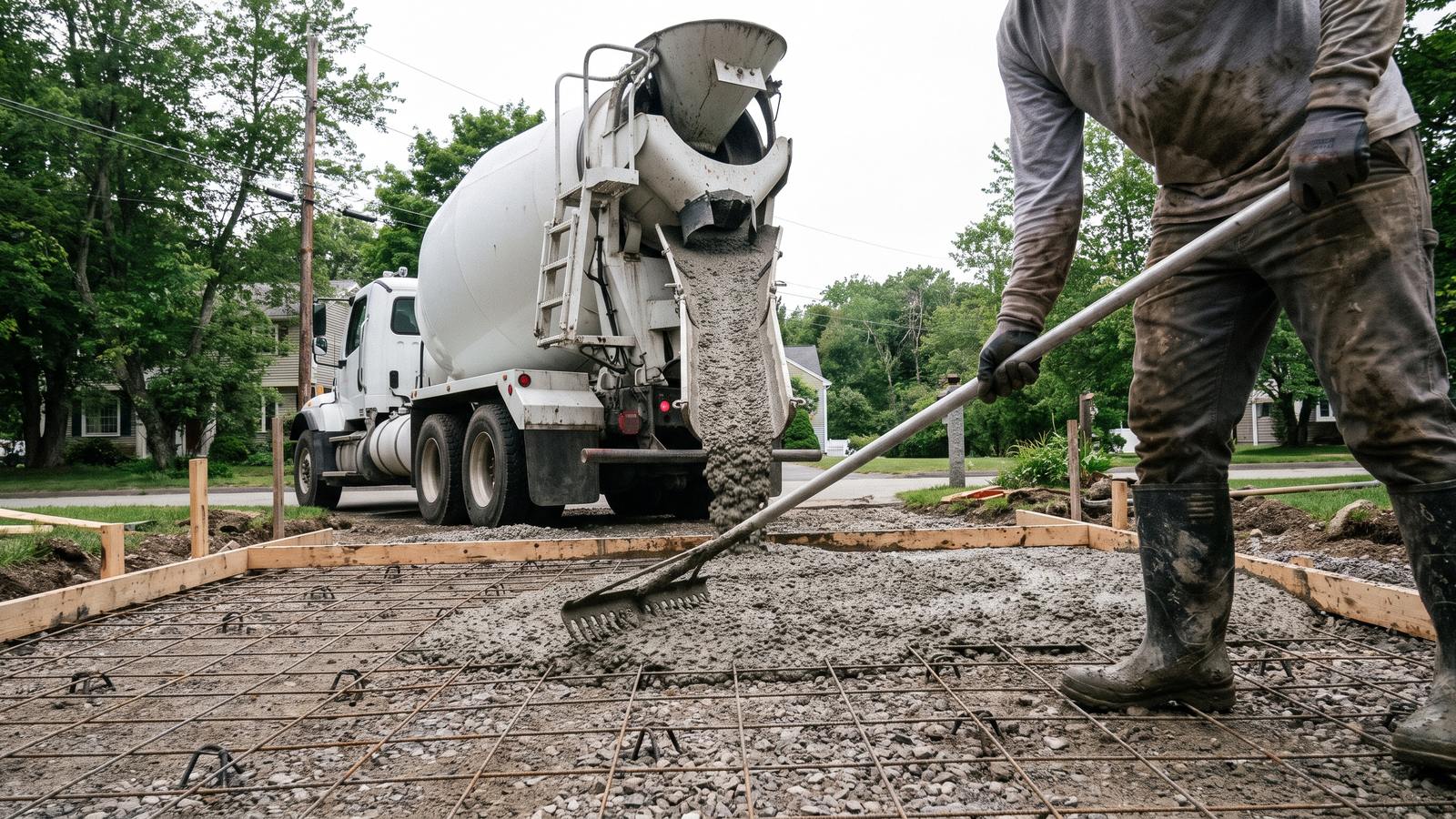
What concrete work costs in Portland, Maine
No price list: every quote is built from the job's size, ground, access, mix, finish, permits and season.
Why every concrete job gets its own written price
What concrete work costs in Portland depends on the job in front of us, so we price each one after measuring it, looking at the ground and seeing how a truck gets in, and we put that price in writing.
We are a concrete contractor, and this page is our plain account of what moves the number for concrete work in Portland, Maine: driveways, patios and walks, steps, garage and basement slabs, foundations and repairs. There is no price list here, because a number without the job behind it is only a guess.
Two jobs of the same size can price very differently. One driveway has firm gravel under it and room for the truck at the curb. Another needs old concrete broken out, soft silt dug away, a pump to reach the back of the lot, and an apron built to the City's standards at the sidewalk. The size is the same; the work is not.
So our quotes break the job into lines: tear-out, excavation and base, forms, reinforcement, the concrete mix, placing and finishing, joints, curing and protection, permits and cleanup. You can see what each part costs and set it beside another contractor's quote. The sections below explain each factor as it applies here, what Maine law says a written home construction contract must contain, and how to compare quotes.
To start, tell us what you want poured or fixed, roughly how big it is, what is there now and how a truck would reach it. That is enough to book a visit.
Free quote
Get a free written quote
Size, tear-out and the ground under the slab
The first things that set a concrete price are how big and thick the job is, what has to be removed first, and what the ground needs before any concrete goes in.
Size and thickness
Area times thickness is the concrete we order, and forms, base, placing and finishing all grow with the area. Thickness follows the load: a walk carries people, a driveway carries cars, and a slab under a truck or camper needs more. A thicker slab also changes the joint layout, since NRMCA ties joint spacing to thickness, at no more than 24 to 36 times the depth.
Tear-out and disposal
Breaking out an old slab, old asphalt or a set of steps, loading it and hauling it away is its own line. Concrete with steel in it takes longer to break up, and wherever new work meets something that stays, we saw a clean edge first.
Excavation, ledge and clay
The ground is the least predictable cost. Ledge, the Maine word for bedrock, is commonly hit in shallow digs, and the Maine Geological Survey says its surface is irregular and only test borings or geophysical surveys give its depth precisely, so a dig can find rock where none shows. Much of the region sits on the Presumpscot Formation, a silty glacial-marine mud that can be a sticky mess when dug, and silty soil is the kind that heaves in frost, so soft spots come out and clean gravel goes back. Wet ground may need drainage, such as an underdrain, before the base goes in.
Getting the concrete from the truck to the forms
If a ready-mix truck can back up to the forms, the concrete goes straight down the chute; if it cannot, the job needs a pump or a long carry, and that adds cost.
Access is a real question in Portland. The city sits on a peninsula in Casco Bay, 45.8 percent of its housing was built in 1939 or earlier, and Munjoy Hill and Parkside have many triple-deckers. A backyard patio behind a house like that, or new steps on a slope such as Munjoy Hill, which rises to 161 feet, can be out of the chute's reach. A line pump moves concrete through a hose over a fence or along a side yard, and wheelbarrows go where a pump cannot. Either one adds equipment or labor.
Island jobs
Island jobs are priced on their own. The Peaks Island car ferry takes commercial vehicles by reservation, up to two a run on weekdays, booked at least 24 hours ahead, with a separate class for trucks of 11,000 GVW and over. The car ferry to down-bay islands such as Great Diamond and Cliff has a 5,500-pound limit including cargo, so a loaded mixer cannot use it. We work out how the concrete and equipment get across, and the timing around the boats, before we price an island job.
Steel, mix, finish and forms
After size and access, the specification sets the price: whether there is steel in the slab, the strength and air content of the concrete, the finish, and how much forming the shape needs.
- Reinforcement. Rebar or welded wire mesh adds material and the time to set it on supports in the slab. Steel holds cracks tight; it does not replace control joints.
- The mix. Outdoor concrete here should be air-entrained, and NRMCA's guidance for concrete that will see deicers is 4,000 psi with about 6 percent total air. The model residential code sets 3,500 psi for exposed steps, porches and garage floors where weathering is severe, with 5 to 7 percent air. A stronger, air-entrained mix costs more than a basic one, and it is the one we order for anything that will see salt.
- Finish. A broom finish is the baseline. Stamped and colored concrete add color, pattern mats, more hands at the pour and a sealer that needs renewing; exposed aggregate adds washing the surface at the right moment.
- Forms, steps and footings. Straight forms are quick to set; curves, changes of level and steps are not. Steps that need footings below the frost line add digging and concrete: Gorham and Yarmouth both call for 48 inches, and for a Portland job we confirm the depth with the City's Permitting and Inspections office.
Our pages on concrete driveways and patios and walkways show how these choices play out on each kind of job.
How the season and permits change the price
A pour in cold weather and any work in the street both add cost: the first needs protection from freezing, and the second needs City permits and follows the City's calendar.
Cold-weather protection
Under ACI 306, a pour is cold-weather work when the air has fallen to 40°F, or is expected to fall below it, during the protection period, and the concrete must be kept from freezing until it reaches at least 500 psi. That means clearing snow, ice and frost, making sure everything the concrete touches is above freezing, sometimes heating or insulating the ground first, then blankets or heat afterward. Accelerating admixtures speed setting, but NRMCA notes they do not stop concrete from freezing. Nights at or below freezing average 6.3 in October and 18.3 in November at the Jetport, so a fall pour may carry some of this cost, and most flatwork is poured in the warmer months. Our guide to pouring concrete in cold weather goes further.
Permits and the street
Work in the public way costs more than work on your lot. A new or changed curb cut needs the consent of the City's traffic engineer and public works authority (City Code Sec. 25-101), and digging in a street or sidewalk needs a street opening permit, held by a contractor with the City's excavator's license (Sec. 25-119). From November 15 to April 15 the City grants those permits only in emergencies or special conditions, and it adds a surcharge to any non-emergency permit issued then (Sec. 25-133). A building permit taken out after work has begun costs double (Sec. 6-92(d)). After the job, a large new slab can add a unit to Portland's stormwater charge, which is billed on impervious area in units of 1,200 square feet (Sec. 24-84). Two things are free: utilities mark their buried lines once the excavator calls Dig Safe at 811, and MaineDOT does not charge for driveway permits that do not affect the highway.
What a written concrete quote must contain in Maine
Under the Maine Home Construction Contracts Act, any home construction contract for more than $3,000 in materials or labor must be in writing and signed by both the contractor and the homeowner (10 M.R.S. §1487).
The Act covers contracts to build, remodel or repair a residence, meaning a home of three or fewer units and its garages. Its definition does not name driveways or patios, so we do not rely on whether it reaches a given flatwork job; we write every concrete quote to its standard. The contract lists:
- both parties' names, addresses and phone numbers, and where the job is
- an estimated start date and substantial-completion date
- the total price and the method of payment, with the first down payment no more than one-third of the total contract price
- a general description of the work and the materials
- the promise the Act requires: materials free of faults, work built to the applicable building code, done in a skillful manner and fit for use
- a choice of binding arbitration, nonbinding arbitration or mediation for disputes
- a change-order clause
- a clear notice pointing to the Attorney General's website, with the AG's consumer statement attached as an addendum
Every change after signing goes on a written change order that states the previous price and the revised price and is signed by both parties (10 M.R.S. §1488). The two sides can set the Act's requirements aside only after the contractor explains the homeowner's rights and both agree (§1489). The Attorney General's page on home construction contracts has the consumer statement in full.
How to compare concrete quotes
Compare quotes line by line, not by the total, because two prices only mean something when they describe the same job. Check that each one states:
- the area and thickness, and what is being torn out and hauled away
- the base: how deep the dig goes and what gravel goes back
- the mix: strength in psi and whether it is air-entrained
- the steel, the control joint spacing and the finish
- curing and, for a fall pour, cold-weather protection
- who pulls which permits and who calls Dig Safe
- start and completion dates, the payment schedule and how changes are priced
Check the contractor as well as the quote. Maine does not license home contractors, and the state's professional licensing office lists no license for concrete work or masonry, so the checking is up to you. The Attorney General's advice is to research a contractor well before choosing one and to ask for a lien waiver each time you pay a contractor or subcontractor.
We quote concrete work in Portland and these nearby towns:
Frequently asked questions
How much does a 20 by 20 concrete driveway cost in Portland?
It depends on what is there now, how thick the slab and base need to be, whether the truck can reach the forms, the finish, and any curb cut or apron work at the street, so we price it after we see it. We measure, check the ground and the access, and give you a written quote with each part of the job on its own line. Send the form or call to set up a visit.
Why are concrete quotes so different from each other?
Usually because they describe different jobs. One quote may include tear-out, a deeper gravel base, 4,000 psi air-entrained concrete, rebar and cold-weather protection, while another leaves some of those out or does not say. Compare the specification line by line before you compare totals.
Is stamped concrete more expensive than a broom finish?
Yes. Stamping adds color, pattern mats, extra hands during the pour and a sealer that has to be renewed, so it costs more than a broom finish on the same slab. A stamped border around a broom-finished field is one way to get the look for less.
Does concrete work cost more in the winter?
Usually, yes. When the air has fallen to 40°F, or is expected to fall below it, during the protection period, ACI 306 calls for keeping the concrete from freezing until it reaches 500 psi, which means heaters, blankets and more labor. In Portland, work in the street or sidewalk also waits, because the City grants no street opening permits from November 15 to April 15 except in emergencies or special conditions.
How much can a contractor ask for up front in Maine?
On a home construction contract, the first down payment can be no more than one-third of the total contract price under the Maine Home Construction Contracts Act (10 M.R.S. §1487). The rest is paid on the schedule written into the contract, and any change to the price needs a written change order signed by both parties.
Does Maine license concrete contractors?
No. The Maine Attorney General's office says Maine does not license or regulate home contractors, and the state's professional licensing office lists no license for concrete work or masonry. The AG's advice is to research a contractor well before hiring and to ask for a lien waiver with each payment.
Want a written price for your concrete job?
Call or send the form, and we will look at the job and put the price in writing.
- What you want poured or fixed, and roughly how big it is
- What is there now: old concrete, asphalt, grass or gravel
- How a truck gets close: the driveway, the yard or a long carry
- When you would like it done, so we can plan around the season