Concrete Contractor Portland Maine
(207) 292-7649Steps and stoops for Portland homes, quoted in writing
Concrete steps in Portland, ME
Front steps, back steps and stoops, set on footings below the frost line or repaired while still sound.
New and rebuilt steps, stoops and landings
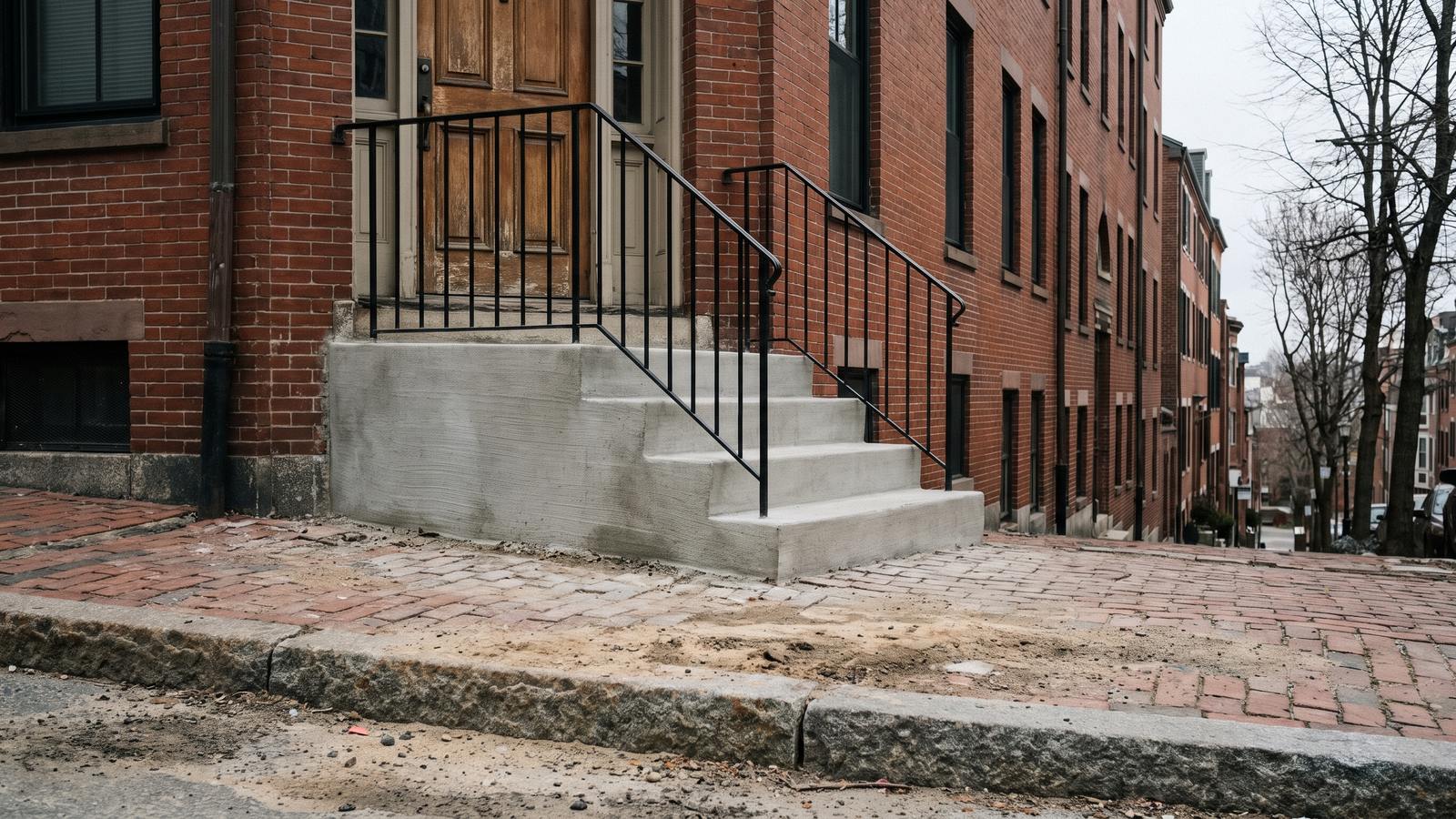
We build and repair concrete steps in Portland, ME: front steps, back steps, stoops and the landing outside the door.
A rebuild starts with tear-out. We break up the old steps, haul them away and dig down to see what they were sitting on. Then we pour a footing below the frost line, build the forms, set the rebar and pour air-entrained concrete, with a broom texture on the treads for grip. Where a standard unit fits the opening, we can set precast steps instead.
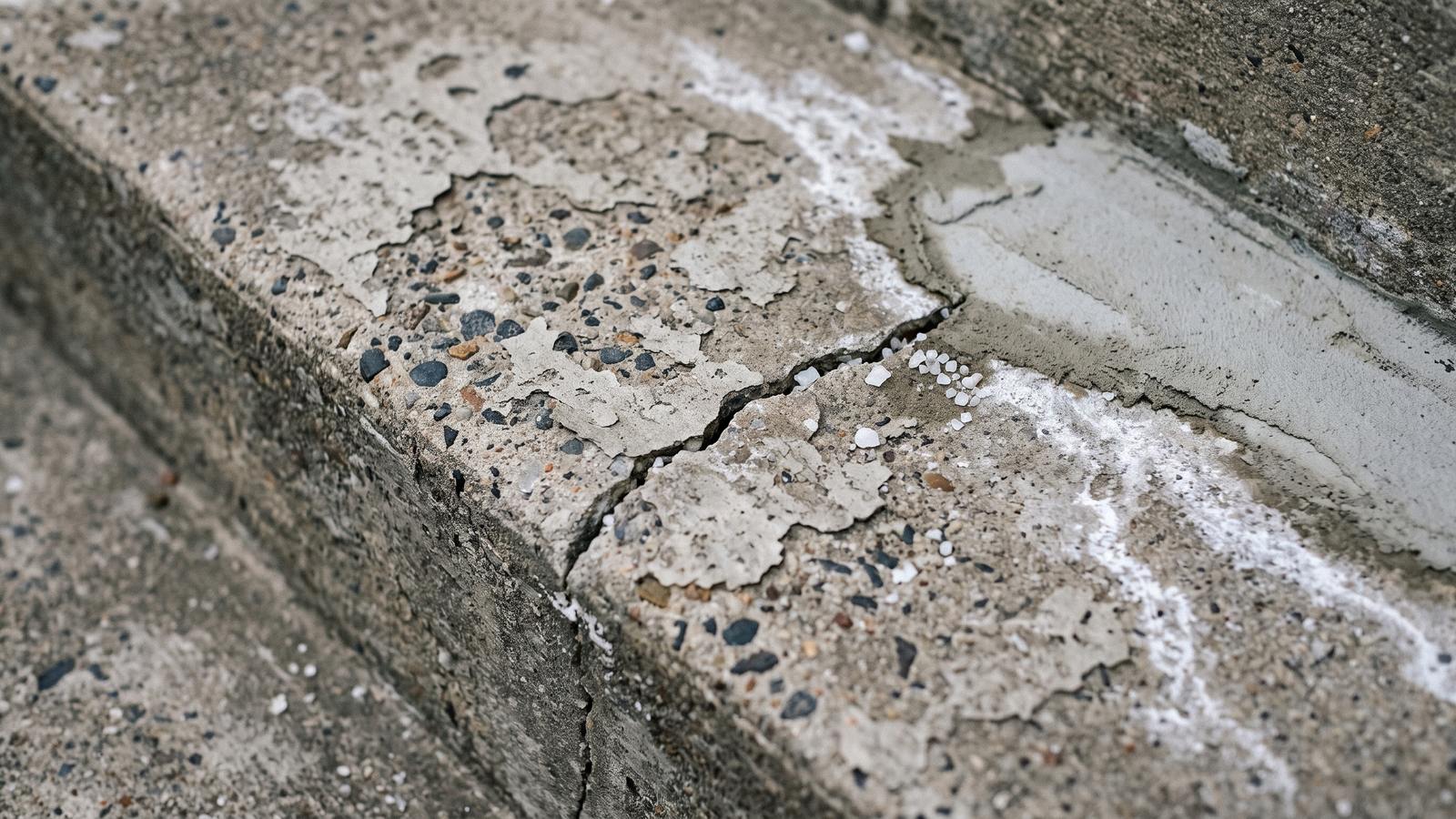
Not every set of steps needs to come out. If yours are still level, solid and tight to the house, and the trouble is a worn, cracked or flaking surface, repairing the damaged concrete may be all they need. If they have heaved, sunk, tipped or pulled away from the door, the problem is underneath them, and a patch will not reach it.
Portland's houses are old: 45.8 percent of the city's housing units were built in 1939 or earlier. Steps on a house that age may already have been patched or rebuilt, sometimes on the original base, and we find out what is under them when they come out. On the triple-deckers common in Parkside and on Munjoy Hill, the front stoop may be the way in for every unit, so we plan the work to keep the time without steps short.
Steps rarely stand alone: the walk that meets them, the landing and the railing all have to line up. As a concrete contractor near you in Portland, we quote the steps and the concrete around them together, in writing, before anything is ordered.
Free quote
Get a free written quote
Why old Portland steps heave, settle and crack
Steps heave, settle and crack when the ground under them moves, and the ground around Portland is prone to it.
Frost heave needs three things: freezing temperatures reaching into the ground, water feeding the freezing zone, and frost-susceptible soil, and the American Concrete Pavement Association notes that heave is generally limited to freezing climates with silty soils. Much of the region sits on the Presumpscot Formation, the marine mud named for the Presumpscot River in Portland; locals call it blue clay, but the Maine Geological Survey says it is mostly silt. Where MaineDOT found it under Route 112 in Saco and Buxton, it rated the subgrade moderately to highly frost susceptible. The winters supply the freezing: at the Portland Jetport the low reaches 32°F or colder on 144.1 days in an average year.
That is why footing depth matters. The house usually rests on a foundation that reaches below the frost; steps on a shallow base ride up with the frost and settle back when it thaws, never quite the same way twice. Over the years they tip, open a gap at the threshold, and crack where one part is held and another lifts.
Settling adds to it: fill that was never compacted keeps sinking, and a downspout emptying beside the stoop washes out the base and feeds water to the frost. Our guide to why concrete steps heave in Portland goes further.
What sets the price of new concrete steps
The price of new steps depends on their size, what comes out first, how deep the footing goes and how easily concrete reaches the spot.
- Size: how many steps, how wide, and the size of the landing.
- Tear-out: breaking up and hauling away the old steps, whether concrete, brick or stone.
- Footing: how deep it goes, and whether the dig hits wet clay, old fill or ledge.
- Access: whether the truck can pull up close or the concrete is pumped or wheeled in.
- Poured or precast: forming on site, or setting a plant-made unit.
- Railing and finish: sleeves or anchors for a railing, and the tread texture.
- Season and paperwork: cold-weather protection, and any permit or historic review.
Each is a line in our written quote. For how concrete jobs are priced more generally, see what drives the cost of concrete work.
Poured or precast, and how we build steps that stay put
Steps stay put when they sit on a footing below the frost line, over a base that drains, and are made of air-entrained concrete that can take freeze-thaw and salt.
Footings and base
We set step footings below the frost line. Gorham and Yarmouth both call for 48 inches; for a Portland job we confirm the depth with the City's Permitting and Inspections office. Where ledge, the Maine word for bedrock, sits close to the surface, the model residential code lets a footing bear on solid rock instead. Clean, compacted gravel goes under the landing, and where the steps meet the house we leave an isolation joint, as NRMCA advises where concrete meets a wall.
The concrete
The model residential code calls for 5 to 7 percent entrained air where weathering is moderate or severe, and a 3,500 psi minimum for exposed steps where it is rated Severe, as Yarmouth's adopted table rates it. Because steps get salted, we follow NRMCA's advice for concrete exposed to deicers: 4,000 psi with about 6 percent air when the stone is 3/4-inch or 1-inch. Rebar ties treads, risers and landing into one piece.
Rise, run and railings
Every riser gets the same height and every tread the same depth; uneven steps are the ones people trip on. We confirm the dimensions, and whether the code calls for a handrail, with the City before we form, and set sleeves or anchors for any railing in the fresh concrete.
Poured or precast?
Precast steps are cast in a plant in standard sizes and set in one piece, with no forming or curing on site. Poured steps are formed to the exact width, rise and landing your door needs. Both need a base underneath that will not heave, and where a precast unit would fit, we price both.
When steps can be poured in Portland
Most steps are poured in the warmer months, once the ground has thawed; a pour in cold weather takes protection, and some winter days rule it out.
NOAA's 1991-2020 normals for the Portland Jetport put the median last spring freeze on April 26 and the median first fall freeze on October 15. November averages 18.3 days with a low of 32°F or colder, and December 26.7.
ACI 306 counts any time the air is at or expected to fall below 40°F during the protection period as cold weather. New concrete has to be kept from freezing until it reaches at least 500 psi, which NRMCA puts at about two days for most concrete kept at 50°F, and kept out of freeze-thaw cycles until it reaches 3,500 psi. Fresh concrete that freezes can lose more than half its potential strength and will not be durable.
So a late-season pour gets blankets or heat and a curing compound or plastic instead of water curing, and no concrete goes onto frozen ground, snow, ice or frost. If your steps fail in midwinter, call anyway: we can look at them, quote the job and set a pour date for when the ground and the air allow it.
Permits, historic review and Dig Safe
Replacing steps can need a City permit, and front steps in a historic district can need historic review, so we check both before we design anything.
Sec. 6-92(a) of the City Code requires a permit before anyone constructs, alters or repairs a building or structure, and the permit fee doubles if it is taken out after work has started. The City's building permit FAQ does not say whether steps need one, so we ask the City's Permitting and Inspections office before the job starts.
Front steps in a historic district get a closer look. The City's Historic Resources Design Manual, adopted March 4, 2026, makes every exterior alteration in a historic designation that can be seen from a public way subject to review, by staff or the Historic Preservation Board depending on scope. The land use code exempts some work, including work not visible from the street and ordinary maintenance. The City's 2014 application form listed exterior stairs among the changes needing approval. Munjoy Hill became a historic district in April 2021, and the West End includes the Western Promenade Historic District.
Digging footings with power equipment is excavation under Maine's Dig Safe law, which treats whoever contracts for a dig as an excavator too. We mark the area and notify Dig Safe at 811 at least three business days, and no more than 30 calendar days, before we dig.
Caring for new steps, and what happens when you call
New steps last longest with no salt in their first winter, no standing water, and a breathable sealer once they have cured.
- First winter: PCA says concrete poured late in the year should get no deicing chemicals its first winter; use clean sand for traction.
- Wrong deicers: never use products containing ammonium sulfate or ammonium nitrate, which PCA says rapidly disintegrate concrete; NRMCA adds magnesium-based salts. More in our guide to deicers and new concrete.
- Sealer: a breathable silane or siloxane sealer, which NRMCA recommends for concrete exposed to deicers, helps keep water and salt out.
- Water: point downspouts away from the steps. Frost heave needs water, and a gutter emptying beside the stoop supplies it.
What happens when you call
- We ask about the steps and the house, and for photos if you have them.
- We look at the steps, the ground around them and how a truck will reach them.
- We check the permit and any historic review with the City.
- You get a written quote listing the work and the materials.
- We notify Dig Safe, book the pour for suitable weather and build the steps.
Frequently asked questions
Why are my concrete steps pulling away from the house?
Because the steps are moving and the house is not. A house sits on a foundation that usually goes below the frost line, while steps on a shallow base rise and settle with frost and water. Much of the Portland area sits on Presumpscot clay, which is mostly silt, and in a freezing climate silty soil is where frost heave happens. The lasting fix is new steps on a footing below the frost line.
Can old concrete steps be repaired instead of replaced?
Yes, if they are still level, sound and snug against the house. Surface flaking, small cracks and chipped edges can often be repaired. If they have lifted, dropped or leaned away from the door, the trouble is below them, and replacing them on a proper footing is the fix that lasts.
How deep do footings for concrete steps need to be in Maine?
Below the local frost line. Gorham requires foundations 48 inches below grade and Yarmouth's code sets a 48-inch frost line; for a Portland job, we check the depth with the City's Permitting and Inspections office before we dig. Where ledge is close to the surface, the model code also allows a footing to bear on solid rock.
Do I need a permit to replace front steps in Portland, Maine?
Possibly, and we find out before work starts. Portland's code requires a permit to build, alter or repair any building or structure, and the City's permit FAQ is silent on steps, so we ask Permitting and Inspections. In a historic district, a change to front steps that can be seen from the street may also need historic review.
Can I put salt on new concrete steps?
Not in their first winter, especially if they were poured late in the year; use clean sand for traction instead. After that, never use a deicer containing ammonium sulfate or ammonium nitrate, which breaks concrete down quickly, and NRMCA also advises against magnesium-based salts. Shoveling early and keeping water from pooling on the treads helps too.
Planning new front steps in Portland?
Call or send the form, and we will look at the steps and the ground under them before we put a price in writing.
- Photos of the steps from the front and from the side
- How many steps there are and roughly how wide they are
- Whether the house is in a historic district, if you know
- Where a concrete truck can park in relation to the steps