Concrete repair in Portland, ME
Cracks, scaling, spalling and sunken slabs or steps, with a straight answer on repair versus replacement.
Fixing damaged concrete, starting with the cause
We handle concrete repair in Portland, ME: cracked walks and driveways, flaking and pitted steps, and slabs that have sunk, tipped or heaved.
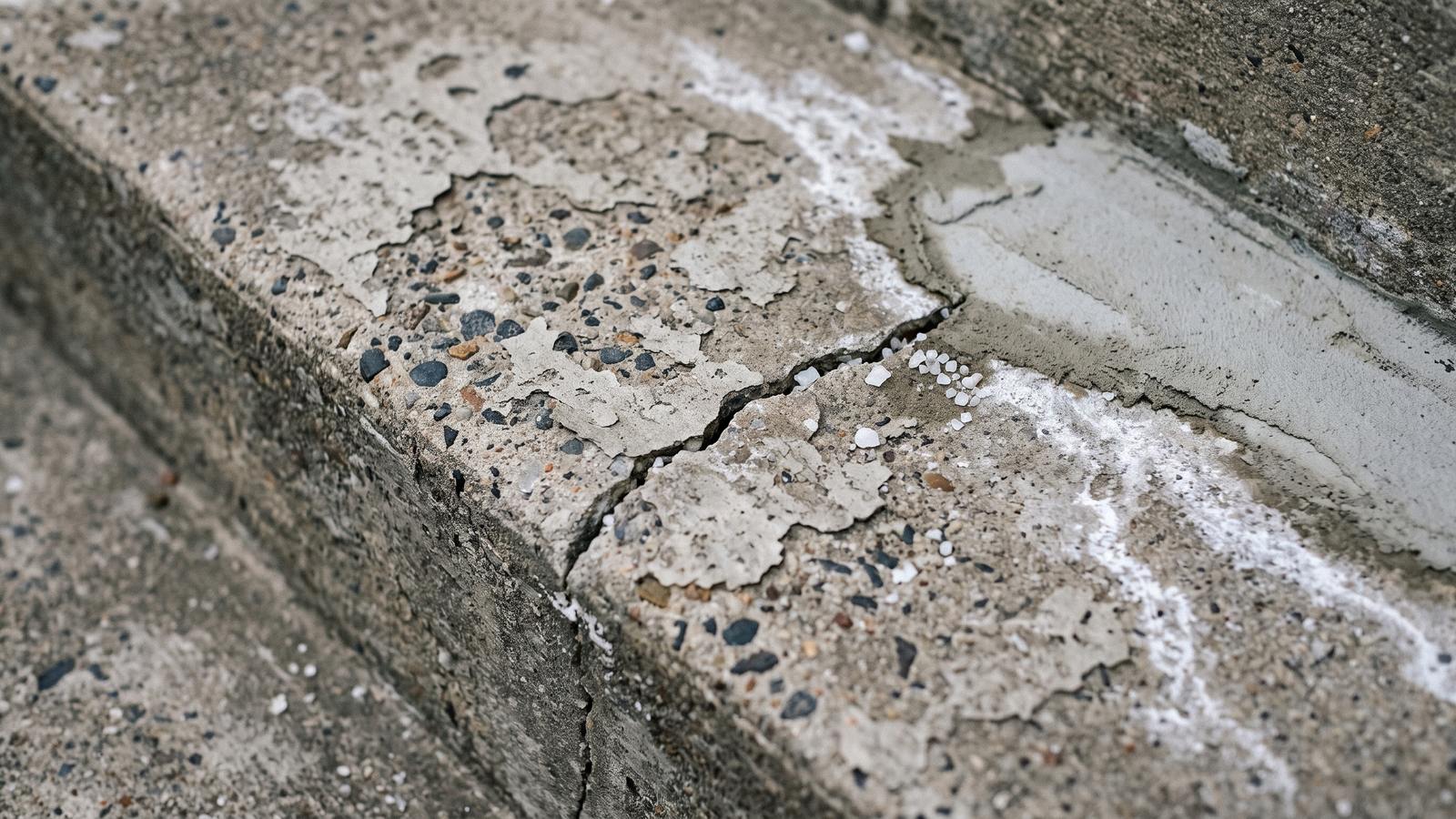
Every repair starts with why the concrete failed. Surface damage, like scaling and spalling, comes from freezing and thawing, deicers, and how the concrete was mixed, finished and cured. Movement, like sinking, heaving and tipping, comes from the ground: frost, water and soft or silty soil. The fix is different for each, and a repair that ignores the cause does not last.
Portland's winters test concrete hard. An average year at the Portland Jetport brings 144.1 days with a low of 32°F or colder but only 40.7 days when the high stays at or below freezing, so on many days the air drops below freezing overnight and climbs above it by afternoon. Normal snowfall is 68.7 inches, and the salt that comes with it makes freeze-thaw damage worse.
So we look before we quote: whether the concrete is still level, whether cracks have opened or offset, how deep the flaking goes, whether steel is showing, and where water runs when snow melts. Then you get a straight answer. Some damage can be sealed, patched or resurfaced. Some concrete is past saving, and we will say so rather than sell a patch that will not survive the next winter.
Because we are concrete contractors in Portland who pour new work as well as fix old, we can price a repair and a replacement side by side. We work on concrete only; we do not repair or pave asphalt.
Free quote
Get a free written quote
Which concrete cracks matter
The cracks that matter are the ones that move: cracks that widen, cracks where one side sits higher than the other, and cracks that let water under the slab.
Concrete shrinks as it dries, and PCA notes that shrinkage rises with the water content of the mix. That is why slabs have control joints: planned cracks, cut or tooled so the slab breaks in a straight line where it is meant to. A thin, tight crack between joints, with both sides level, is usually shrinkage, and sealing it to keep water out is often all it needs.
These are the cracks we look at harder:
- Offset cracks, where one edge sits higher than the other. That is movement underneath, and on a walk it is a trip hazard.
- Cracks that widen from one season to the next, a sign that the ground or the base is still moving.
- Cracks with rust stains or spalling along them, which can mean reinforcing steel is rusting; PCA lists rusting steel among the causes of spalling.
- A gap where steps meet the house, which points to frost heave or settling under the steps.
- A slab broken into several pieces, which usually means the base under it has failed.
Sealing a crack that is still moving does not stop the movement; it only covers it until the next freeze.
Scaling and spalling from freeze-thaw and deicers
Flaking concrete is scaling, which PCA defines as surface mortar breaking away under freezing and thawing, driven mainly by the pressure of freezing water and made worse by deicers.
PCA says wet, low-strength concrete without entrained air is the most prone to scale, and it can scale young; finishing while bleed water is still on the surface leads to scaling too. NRMCA's list of causes adds too little entrained air, poor curing, overworking the surface, and deicers on concrete without enough air or strength. Spalling goes deeper: PCA describes round or oval pits, or long cavities along joints, from internal pressure, bond failure in two-course work, impact, weathering, poorly built joints or rusting steel.
Which deicers damage concrete
- Ammonium sulfate and ammonium nitrate: PCA says deicers containing them rapidly disintegrate concrete and should never be used.
- Magnesium-based salts: NRMCA's 2014 guidance says never to use them as deicers.
- Calcium chloride and magnesium chloride: FHWA explains that both attack the cement paste chemically, forming calcium oxychloride, which expands and breaks the paste down.
- Any deicer on new concrete: PCA's advice is that a slab poured late in the year gets none in its first winter, and NRMCA recommends clean sand for traction instead.
When we replace scaled concrete, we order it to resist the same attack: NRMCA's recommendation for concrete exposed to deicers is 4,000 psi and about 6 percent air with 3/4-inch or 1-inch stone, and FHWA adds a water-to-cementitious ratio below 0.45 and a penetrating silane or siloxane sealer. Our guide to salt and new concrete goes further.
Sunken, tilted and heaved slabs and steps
Concrete that sinks, tips or heaves is telling you about the ground under it, and a lasting repair has to deal with the ground.
Lifting is frost heave, and it takes three things at once: frost reaching into the ground, water feeding it, and frost-susceptible soil. The American Concrete Pavement Association says heave is generally confined to freezing climates with silty soils, and the Presumpscot Formation under much of the Portland area is mostly silt; a Maine Geological Survey paper describes it as having high water content and low permeability, so it holds water and drains slowly. Sinking has other causes: fill that was never compacted keeps settling, and water running under a slab from a downspout or a low spot washes fine material out of the base until the slab drops.
A lifted or dropped edge on a walk is a trip hazard, and it is worth fixing before snow hides it.
Fixing the ground, not just the slab
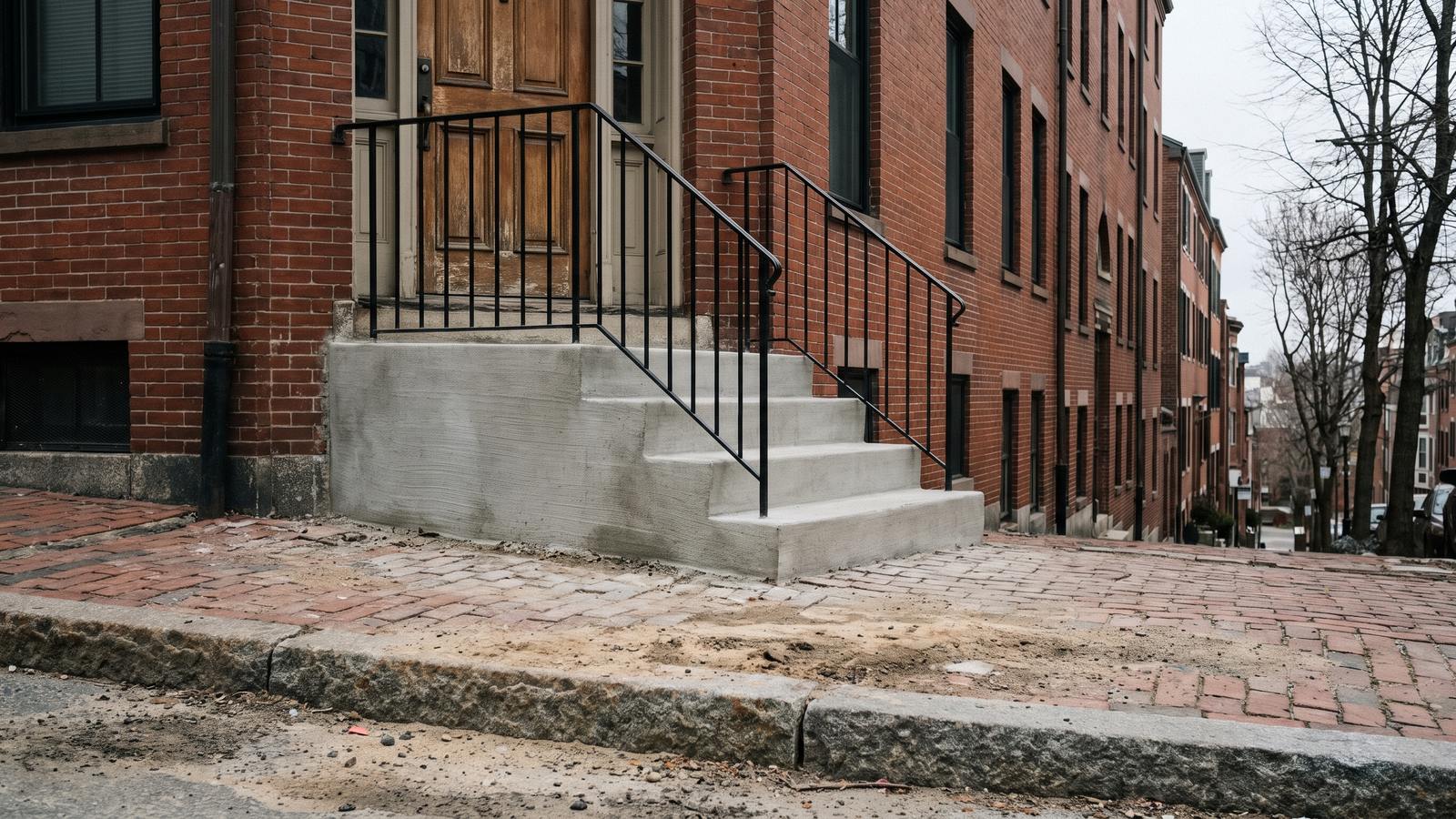
Raising a sunken slab or grinding down a lifted edge can work when the ground has stopped moving. If the base is still soft, wet or frost-susceptible, the concrete is likely to move again. Where the base has failed, we take out the panel, dig out silt and soft spots, rebuild with clean compacted gravel, fix the drainage that caused the washout, and pour new concrete. Steps that have pulled away from the house usually need new steps on a proper footing.
The sidewalk in front of your house
If the heaved slab is the City sidewalk, it is not ours to fix. Portland's public works authority repairs and maintains the sidewalks and curbing the city built, at the city's expense (City Code Sec. 25-104), and curb and sidewalk may be removed only by the city or under a public works permit (Sec. 25-101). We are not the City's contractor, so that call goes to the City.
What sets the price of a concrete repair
A repair is priced by what is wrong, how much of it there is and what has to happen underneath, not just by the size of the damaged area.
- The cause: sealing a stable crack is a small job; rebuilding a washed-out base is not.
- How much is damaged: a few spalls, or scaling across a whole walk.
- Repair or replace: surface preparation and repair material, or tear-out, haul-away, base work and new concrete.
- Access: whether a truck can reach the spot or material goes in by wheelbarrow.
- Drainage: moving a downspout or regrading so water stops undermining the concrete.
- Season: repairs in cold weather need heat, blankets and more time.
When any concrete contractor quotes a repair, ask what caused the damage and what happens if the cause is still there. Our written quote answers both, and when a repair and a replacement are close, it prices both. More on how we price concrete jobs.
Patch, resurface or replace: how we decide
We repair concrete when the base is sound and the damage is shallow, and we recommend replacing it when the base has failed or the damage runs deep.
- Seal: a stable, level crack. Keeping water out slows freeze-thaw damage.
- Patch: isolated spalls, chipped step edges and broken corners in concrete that is otherwise sound and level.
- Resurface: light scaling over concrete that is still sound, level and not moving. The new layer has to bond to clean, sound concrete, and PCA lists bond failure in two-course work among the causes of spalling, so preparation decides whether it holds.
- Replace: concrete that has heaved, sunk or tipped, slabs broken into pieces, deep or widespread scaling and spalling, rusting steel near the surface, and steps pulled away from the house. A driveway in that state is usually better off as a new driveway on a rebuilt base.
When a patch will not last a Maine winter
A patch fails when it is asked to hold what it cannot. It will not hold if the slab under it is still moving, because the next frost cracks the patch along with the slab. It will not hold on concrete that is saturated and scaling throughout, because the old surface keeps breaking away beneath it. And it will not hold if it goes in too late in the season: ACI 306 calls it cold weather once the air has fallen, or is expected to fall, below 40°F while fresh concrete still needs protection, and concrete that freezes while fresh can lose over half the strength it would otherwise reach.
In those cases we will tell you plainly that replacement is the fix that lasts, and quote it. If the right time for that is spring, we can plan it now.
When repairs are done, and how to make them last
Most concrete repairs are done in the warmer months, when the air and ground are above freezing; a repair in cold weather needs protection until it gains strength.
NOAA's 1991-2020 normals for the Portland Jetport give a median date of April 26 for the last spring freeze and October 15 for the first fall freeze. We do not place concrete on frozen ground, snow, ice or frost, and new concrete has to be protected from freezing until it reaches at least 500 psi; NRMCA puts that at about two days at 50°F for most concrete.
City Code Sec. 6-92(a) requires a permit to repair a building or structure, not only to build one, so we confirm with Permitting and Inspections whether a particular repair needs one. In a historic district, the land use code exempts ordinary maintenance from historic review, while the City's Design Manual makes any exterior alteration visible from a public way subject to it.
Sealing and care
- Seal stable cracks so water stays out of them.
- Consider a breathable silane or siloxane sealer on concrete that gets salted; NRMCA recommends one for concrete exposed to deicers.
- Skip deicers containing ammonium sulfate, ammonium nitrate or magnesium-based salts, and use clean sand on new repairs through their first winter.
- Shovel before snow packs down and keep meltwater from pooling; freezing water in the surface is what drives scaling.
- Point downspouts away from walks, steps and slabs.
Next step
Send photos through the form or call. We will ask what you have noticed and when it started, look at the damage, and tell you in writing whether it calls for a repair or a replacement.
Frequently asked questions
Why is my concrete flaking or peeling?
That is scaling: surface mortar breaking away as water in the surface freezes and thaws, made worse by deicers. PCA puts wet, low-strength concrete with no entrained air at the greatest risk, and finishing while bleed water is on the surface, poor curing and overworking the surface all add to it. Shallow flaking can be repaired; deep or widespread scaling usually means replacement.
Can scaled or pitted concrete be resurfaced?
Yes, if the concrete underneath is sound, level and not moving, and the damage is shallow. A resurfacing layer only lasts if it bonds, and PCA names bond failure in two-course work as one cause of spalling, so the surface has to be cleaned and prepared down to sound concrete. Over a moving or badly deteriorated slab, resurfacing tends to fail, and replacement is the better fix.
What ice melt is safe for concrete?
No deicer is good for concrete, and some are much worse than others. PCA says never to use deicers containing ammonium sulfate or ammonium nitrate, NRMCA says never to use magnesium-based salts, and FHWA explains that calcium chloride and magnesium chloride attack the cement paste chemically. On concrete in its first winter, use clean sand for traction instead.
Should I repair or replace a cracked concrete driveway?
Repair it if the cracks are tight and level and the slab is still sound, and seal those cracks so water stays out. Replace the affected panels, or the whole driveway, if slabs have sunk, heaved or broken into pieces, or if scaling covers most of the surface. We look at the base and the drainage before we recommend either.
Why is my concrete walkway sinking or lifting?
Sinking usually comes from soft fill settling or water washing out the base, and lifting usually comes from frost heave. Frost heave needs freezing ground, water and frost-susceptible soil, and it is generally limited to silty soils like the Presumpscot clay under much of the Portland area. A lasting repair fixes the base and the drainage, not just the slab.
Who fixes a broken sidewalk in front of my house in Portland?
If the City built it, the City does: Portland's public works authority repairs and maintains city-built sidewalks and curbing at the city's expense under City Code Sec. 25-104. Only the city, or someone holding a public works permit, may remove curb or sidewalk, so contact the City rather than a private contractor. Your own walk, steps and driveway are yours to repair.
Concrete cracked, flaking or sinking in Portland?
Send photos or call, and we will tell you whether it can be repaired or should be replaced.
- Photos of the damage, close up and from a few steps back
- How old the concrete is, if you know
- When you first noticed it: after a winter, after salting, or gradually
- Which deicer has been used on it