Concrete Contractor Portland Maine
(207) 292-7649Driveways, aprons and replacements, priced in writing
Concrete driveways in Portland, ME
New driveways and tear-out replacements, built from the gravel base up to the apron at the street.
What a new concrete driveway involves
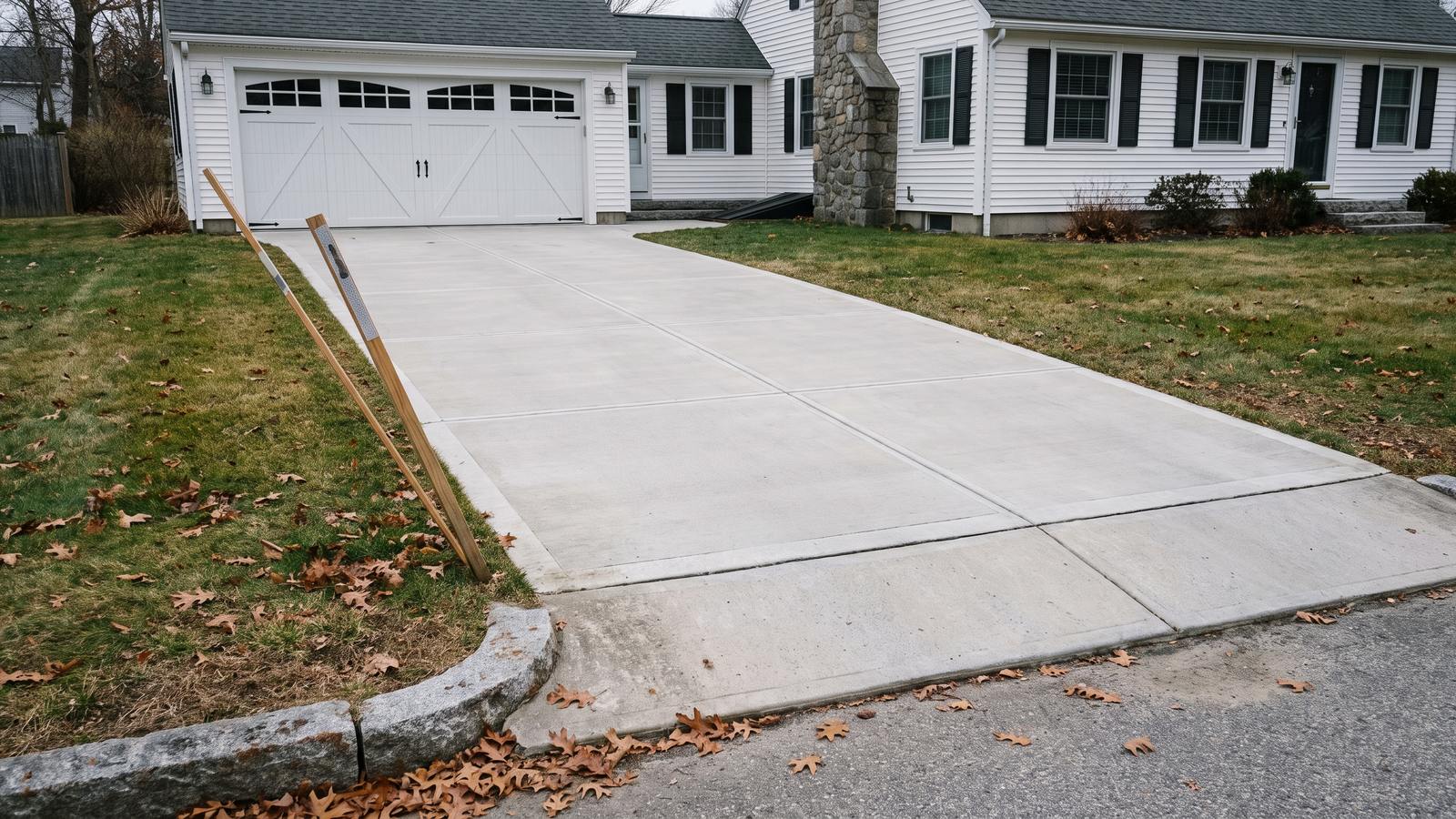
A new concrete driveway is four jobs done in order: clear out what is there, build a compacted gravel base that drains, pour and finish an air-entrained slab, then keep it curing until it is ready for cars.
We are a concrete contractor in Portland, Maine, and we pour concrete, not asphalt. Whether you are paving a gravel lot for the first time or replacing a slab that has heaved and cracked, we build concrete driveways in Portland, ME the same way: from the ground up, finishing at the street.
A replacement starts with tear-out. We saw a clean line wherever new work meets something that stays, such as the garage slab or a front walk, then break out the old concrete or asphalt, load it and haul it away. Underneath, we dig down to firm ground, take out soft or wet soil, and put back clean gravel compacted in layers.
Next come the forms, set to a grade that carries water away from the house and garage, and the steel if the job calls for it. We order air-entrained concrete for every outdoor pour, finish it with a broom texture for grip, saw the control joints and keep the slab covered while it cures.
The last piece is the apron and curb cut at the street. They sit in the public way, so the City sets its own rules for their width, material and timing. The sections below cover those rules, along with what sets the price, the choices in the specification, the season and how to care for new concrete in its first winter.
Free quote
Get a free written quote
What sets the price of a concrete driveway
Size, tear-out, the ground and access set most of a driveway's price; the finish and the street end add the rest. Two driveways of the same size can need very different work under the concrete, so we price each one after a visit to the site.
- Size and thickness. Area and thickness set how much concrete we order, and the forms, base and finishing grow with the area. A driveway for a delivery truck or a camper needs more thickness than one for two cars.
- Tear-out. Breaking out old concrete or asphalt and hauling it away is its own line, and slabs with steel in them take longer.
- The ground. Soft, wet silt is dug out and replaced with gravel, and ledge near the surface is taken down or worked around.
- Access. If the mixer cannot back up to the forms, we pump the concrete or wheel it in.
- The street end. A new or wider curb cut, or an apron doweled into a concrete sidewalk, means City permits and work in the public way.
- Finish and extras. A broom finish is standard; a stamped or colored border, a trench drain or steps up to the house add cost.
Each is its own line on our written quote. Our guide to what drives concrete prices here covers every factor, including the season.
Base, thickness, steel and the concrete mix
A driveway lasts here when it sits on a base that drains and does not heave, is thick enough for its heaviest load, and is made of air-entrained concrete strong enough for deicers.
A base built for frost
Much of the region sits on the Presumpscot Formation, a glacial-marine mud named for the Presumpscot River in Portland. Locals call it blue clay, but the Maine Geological Survey says it is usually gray and mostly silt, and silty soil is the kind that heaves. We follow the American Concrete Pavement Association's fixes: dig out silt pockets, lay clean gravel, compact it and keep water from collecting under the slab. Where ledge, the Maine word for bedrock, rises high, we take down the high spots and level over it with gravel.
Thickness and steel
Thickness follows the heaviest vehicle, and joint spacing follows thickness: NRMCA keeps joints no more than 24 to 36 times the slab depth apart, about 10 feet for a 4-inch slab. Rebar or welded wire mesh does not stop concrete from cracking; it holds cracks tight so the panels stay level. We write both choices into the quote.
Air-entrained concrete
Winters here swing back and forth across freezing: at the Jetport the low reaches 32°F or colder on 144.1 days in an average year, but the high stays at or below freezing on only 40.7. Entrained air, a network of microscopic voids, relieves the pressure of freezing water, and NRMCA says concrete that will see freezing and thawing should have it. For deicer exposure its guidance is 4,000 psi with about 6 percent total air using 3/4-inch or 1-inch stone, and that is what we order for driveways.
Slope, joints and the finish
We pitch the slab so water runs away from the house and garage. Saw-cut control joints decide where it cracks: NRMCA calls for cuts at least a quarter of the slab depth, made 4 to 12 hours after finishing, with no panel more than 1.5 times as long as it is wide. Isolation joints separate the driveway from the garage slab and the steps. The broom finish goes on only after bleed water has left the surface, since PCA ties finishing too early to scaling.
When to pour, and when you can drive on it
Most driveways here are poured from late spring to early fall, and cars stay off new concrete until it has cured for at least 7 days, the minimum PCA gives, and longer when temperatures are near 40°F.
At the Jetport the median last spring freeze is April 26 and the median first fall freeze is October 15, and nights at or below freezing average 18.3 in November, which is why most flatwork is poured in the warmer months. A later pour becomes cold-weather concreting under ACI 306 once the air has fallen to 40°F, or is expected to fall below it, during the protection period. The slab then has to be kept from freezing until it reaches 500 psi, about two days for most concrete kept at 50°F according to NRMCA, because frozen fresh concrete can lose more than half its potential strength. We clear frost from the base, cover the slab with insulated blankets and keep it from freeze-thaw cycles until it reaches 3,500 psi.
Heavy loads, such as a delivery truck or a dumpster, wait longer than cars, because concrete's rated strength is measured at 28 days. We give you those dates in writing on pour day.
Portland curb cut, apron and permit rules
In Portland, everything between your property line and the street, meaning the curb cut, the apron and the sidewalk it crosses, is public way, and none of it can be built or changed without the City's consent.
Curb cuts and driveway width
Under City Code Sec. 25-101, the traffic engineer and the public works authority approve the design and location of every curb cut, and curb and sidewalk may be removed only by the City or under a public works permit. For a home with nine or fewer parking spaces, the City's Technical Manual allows one driveway, 10 to 20 feet wide at the property line and at least 20 feet from any neighboring driveway. On the Eastern Promenade between Atlantic Street and North Street, a driveway curb cut may not exceed 13 feet (Sec. 25-110).
Aprons, sidewalks and brick
A new concrete apron that meets an existing concrete sidewalk must be doweled into it before the pour, and the walking route across the apron must stay at least 5 feet wide with a 2% cross slope. The City's sidewalk policy assigns every street brick, concrete or asphalt, and aprons in the pedestrian zone use that material. In historic districts such as Munjoy Hill and the Western Promenade district, that means brick, and we say so in the quote. Curb is granite, reused where possible.
Street openings and the winter limit
Digging in a street or sidewalk takes a street opening permit, held by a contractor with the City's excavator's license (Sec. 25-119). From November 15 to April 15 the City grants none and allows no opening of paved areas except in emergencies or special conditions, and it adds a surcharge to any non-emergency permit issued in that window (Sec. 25-133). It may also refuse permits to dig into a street for five years after it is built or rebuilt (Sec. 25-138).
State roads, historic review, stormwater and Dig Safe
A new or altered entrance onto a state road, such as Forest Avenue (US 302) or Washington Avenue (Route 26), needs a written permit under 23 M.R.S. §704. Portland is an urban compact municipality, so inside its compact limits the City issues that permit; outside a compact area, MaineDOT does. In historic districts, the City's Historic Resources Design Manual, adopted March 4, 2026, makes every exterior alteration visible from a public way subject to review.
The City's stormwater charge is billed on impervious area in units of 1,200 square feet (Sec. 24-84), and it already counts compacted gravel, so paving a gravel driveway in the same footprint should not add billed area, while widening it or adding a parking pad can. We notify Dig Safe through 811 at least 3 business days before machine digging, and we confirm with the City's Permitting and Inspections office whether the job needs a building permit, since one taken out after work begins costs double (Sec. 6-92(d)). There is more in our post on Portland's driveway and curb cut rules.
Caring for new concrete in its first winter
In its first winter, keep deicing salt off a new driveway where you can, use clean sand for grip, and never use a deicer made with ammonium nitrate, ammonium sulfate or magnesium.
The Jetport averages 68.7 inches of snow a year and 74.2 days with at least an inch on the ground, and cars track salty slush in from the street. PCA says concrete poured late in the year, which may not dry out before its first freeze, should get no deicing chemicals that winter, and NRMCA advises clean sand for traction on new concrete. FHWA explains the chlorides: calcium and magnesium chloride form calcium oxychloride in the cement paste, which expands and breaks the paste down.
Once the slab has cured and dried, a breathable silane or siloxane sealer, which NRMCA recommends for concrete exposed to deicers, cuts down how much salty water soaks in. Read more about deicers and new concrete, or see concrete repair if an older driveway is already flaking.
How we quote your driveway
Call or send the form, and we will measure the driveway, look at the ground and the street end, and send a written quote with each part of the job on its own line. We quote driveways in Portland and these nearby towns:
Frequently asked questions
How long before I can drive on a new concrete driveway?
Keep cars off it until it has cured for at least 7 days, the minimum curing period PCA gives, and longer when temperatures are near 40°F. Heavy vehicles, such as a delivery truck or a loaded trailer, should wait longer, since concrete's rated strength is measured at 28 days. We give you the dates in writing when we pour.
Do I need a permit for a new driveway in Portland, Maine?
For the part at the street, yes: a new or changed curb cut needs the City's prior consent under City Code Sec. 25-101, and digging in the sidewalk or street needs a street opening permit. Whether the driveway on your lot also needs a building permit is something we confirm with the City's Permitting and Inspections office before work starts.
How wide can a driveway be in Portland?
For a home with nine or fewer parking spaces, the City's Technical Manual allows a driveway 10 to 20 feet wide, measured at the property line, at least 20 feet from any neighboring driveway, and no more than one driveway. On the Eastern Promenade between Atlantic Street and North Street, a curb cut for a driveway may not be longer than 13 feet.
Can a concrete driveway be poured in winter in Maine?
It can, with protection, but most flatwork here is poured in the warmer months. ACI 306 calls for keeping the concrete from freezing until it reaches at least 500 psi whenever the air has fallen to 40°F, or is expected to fall below it, during the protection period. In Portland, apron and curb cut work also has to wait, because the City grants no street opening permits from November 15 to April 15 except in emergencies or special conditions.
Will a new concrete driveway raise my Portland stormwater bill?
It can. The City bills its stormwater charge in units of 1,200 square feet of impervious area, rounded to the nearest unit, and it already counts compacted gravel, so paving a gravel driveway in the same footprint should not add billed area. Widening the driveway or adding a parking pad can push the total up a unit.
Does a concrete driveway need rebar or wire mesh?
Not always. Steel does not stop concrete from cracking; it holds cracks tight so the panels stay level, while control joints decide where the cracks go. We choose rebar, welded wire mesh or no steel based on the ground and the loads, and write the choice into the quote.
Planning a new driveway in Portland?
Call or send the form, and we will measure it and put the price in writing.
- Where the driveway is: the street or the neighborhood
- What is there now: gravel, cracked concrete or old asphalt
- The rough size, and the heaviest vehicle that will use it
- Photos of the street end: the curb, the sidewalk and the apron