Concrete Contractor Portland Maine
(207) 292-7649Front steps to footings, with a free quote in writing
Concrete contractor in Falmouth, Maine
Front steps, walkways, patios, driveways and slabs for Falmouth homes, from the Foreside to Blackstrap.
Concrete work for Falmouth homes
At a Falmouth house, the concrete we pour runs from the front steps and stoop to the walk, the patio and the driveway, and on to garage and basement slabs and the footings and frost walls under additions; we also repair concrete that has cracked, scaled or settled.
Falmouth is a town of 12,982 people by the Census estimate for 2025, up from 12,444 in 2020, with an owner-occupied rate of 84.4 percent, and 80.67 percent of its housing units are detached houses. For those houses we replace front steps, walks, patios and drives, pour garage floors and footings for additions, and repair concrete that can still be saved. Lots near Casco Bay and the Presumpscot estuary also bring shoreland rules into play, which the permits section below covers.
Each quote we write names the concrete strength and air content, the base, the reinforcement, the joint layout and the finish, so two quotes can be compared line by line. If you are choosing a concrete contractor in Falmouth, ask everyone you talk to for that same detail. We work as a concrete contractor for Greater Portland, and a Falmouth job starts the way any of ours does: a site visit, the permit questions answered, then a written quote before anything is ordered. We also tell you when a repair will not hold and replacing the concrete makes more sense.
Most flatwork goes in during the warmer months, because concrete that freezes while fresh can lose more than half its potential strength, and a cold-weather pour needs protection to prevent that. Winter is still a good time to measure, settle any street entrance permit and get on the spring schedule.
Free quote
Get a free written quote
What we pour and repair in Falmouth
In Falmouth we pour and repair every part of a house's concrete, from a new walk at a Foreside house to the footings under a garage in North Falmouth. Every card opens the full service page; the short line under it is the Falmouth angle.
Concrete driveways
New and rebuilt drives, with the street entrance permit question answered before any digging.
Learn morePatios and walkways
Patios and garden walks near the bay, sized for the shoreland zone's limit on hard surfaces.
Learn moreConcrete steps
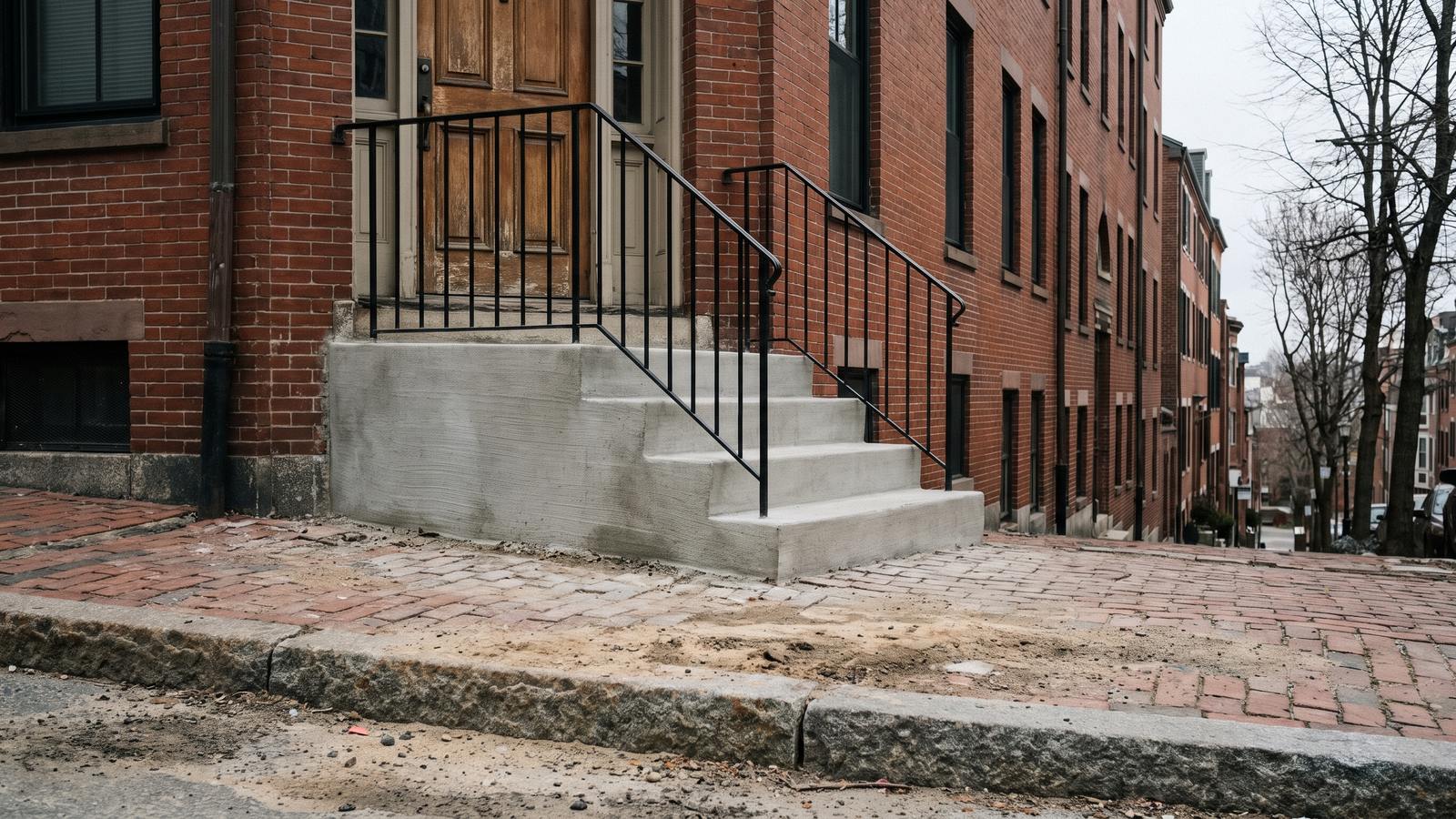
Front steps and stoops on footings below frost, in air-entrained concrete made for snow and salt.
Learn moreSlabs and garage floors
A new garage floor or a replaced basement slab, with control joints saw cut within hours of finishing.
Learn moreFoundations and frost walls
Footings and frost walls under additions and garages, dug to the depth Code Enforcement confirms.
Learn moreConcrete repair
Flaking, cracked or sunken concrete checked for the cause before we recommend a fix or a new pour.
Learn more
Falmouth rules to check before concrete is poured
Falmouth's code FAQ says sidewalks and driveways need no building permit, so for a drive or a walk the rules to check are about the street, the shore and buried lines. Falmouth's Code Enforcement office answers permit questions.
- New entrances. Creating a new access point along a public street needs a Residential Street Entrance Permit (Sec. 14-42). The forms are on the town's street permits page.
- Work in the right-of-way needs an Excavation Permit, filed with proof of liability insurance.
- Newly paved roads. After repaving, the town puts a 5-year moratorium on the road. Owners get 60 days' notice before the paving, and that notice is the time to finish a new entrance or apron.
- Retaining walls up to 4 feet tall need no building permit, measured from the bottom of the footing to the top of the wall, so the buried footing counts toward the height.
- State roads. The state roads here are Route 1 and Routes 9, 26, 88 and 100. Because Falmouth is on MaineDOT's urban compact list, the town handles entrances onto them inside the compact limits, and MaineDOT does beyond them. An existing entrance keeps the use it had on May 25, 2002, but physically altering it, such as widening it, needs a permit.
- Shoreland zoning. Along Casco Bay and the tidal Presumpscot estuary, the shoreland zone runs 250 feet inland from the upland edge of the coastal wetland, and it reaches 75 feet from a stream. Inside it, driveways sit at least 75 feet back from the water, or no closer than 50 feet where there is no reasonable alternative, and stairs down to the shore can be up to 4 feet wide, with a permit.
- Dig Safe. Before machine digging, the area is marked with white paint, flags or stakes and Dig Safe is called at 811. Utility owners get 2 full business days after the call to mark their lines.
What Falmouth's ground, weather and houses mean for concrete
Falmouth concrete has to handle Presumpscot clay and ledge, limits near the river and the bay, and a snowy winter of shovels and deicer.
The Presumpscot River runs through town and empties into Casco Bay at Falmouth, and the marine clay named for its valley lies under much of the region. The Maine Geological Survey calls it a sensitive clay that can deform and flow when disturbed or left unsupported, with landslides most likely on coastal bluffs and along rivers, and it advises against adding weight to slopes. A patio near the top of a bank therefore starts with a look at the slope, not the forms. Ledge, the Maine word for bedrock, is the other unknown, and it commonly turns up in shallow digs such as foundation excavations.
NOAA's 1991-2020 normals for the Portland International Jetport, the regional station, show 68.7 inches of snow a year and 74.2 days with at least an inch on the ground, which means a long season of shovels and deicer on front steps. For steps left out in the weather where the rating is Severe, the model residential code asks for at least 3,500 psi and 5 to 7 percent entrained air; Yarmouth's adopted code table rates it Severe, and we confirm Falmouth's rating with Code Enforcement. On footing depth, Gorham and Yarmouth both call for 48 inches; Falmouth's figure is one we confirm with Code Enforcement before digging.
In the first winter, keep deicers off new concrete as far as you can; the FAQ below has the details. New work is cured for at least 7 days, as the Portland Cement Association advises. The houses span every era, with 14.2 percent built in 1939 or earlier, 41.8 percent from 1970 to 1999 and 26.7 percent in 2000 or later.
Where we work in Falmouth
We work across Falmouth: Falmouth Foreside along Route 88, which runs as Foreside Road within about half a mile of Route 1; Waites Landing, Mackworth Point and York Landing; the streets near Gilsland Farm, Maine Audubon's 65-acre sanctuary on the Presumpscot estuary; and Pleasant Hill, Casco Terrace, Highland Lake, North Falmouth, West Falmouth Corner and Blackstrap. A mixer gets in on Route 1 and Routes 9, 26, 88 and 100, or off the Turnpike at exits 52 and 53. For the neighboring towns we serve, see the chips below.
Frequently asked questions
Does a driveway in Falmouth need a building permit?
No. Falmouth's code FAQ lists sidewalks and driveways among the work that needs no building permit. A new entrance onto a public street may still need a Residential Street Entrance Permit, and digging in the right-of-way needs an Excavation Permit.
How tall can a retaining wall be in Falmouth without a permit?
Up to 4 feet, measured from the bottom of the footing to the top of the wall. Because the measurement starts at the footing, the buried part counts toward the 4 feet. For anything taller, take the plan to Code Enforcement for a building permit.
Can I dig in a newly paved street in Falmouth?
Not for 5 years: the town puts a 5-year moratorium on a road after it is repaved. Owners get 60 days' notice before paving so they can finish work in the right-of-way first, and that is the moment to schedule a new entrance or apron.
What deicer is safe on new concrete steps in Falmouth?
For the first winter, ideally none. Concrete placed late in the season should go through its first winter with no deicing chemicals at all, the Portland Cement Association advises, and NRMCA points to clean sand for grip. Both groups rule out ammonium sulfate and ammonium nitrate deicers entirely, and NRMCA adds magnesium-based salts to that list.
Planning new steps or a walkway in Falmouth?
Call or send the form; we will visit, check the street and shoreland rules, and quote the job in writing.
- Your street and village, such as the Foreside or West Falmouth Corner
- What you want poured or replaced: steps, a walk, a patio or a drive
- Rough sizes, or the number of steps and the height to the door
- Where a truck can park, and how far that is from the work